




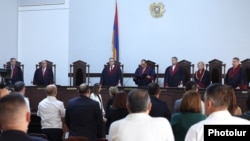
In separate appeals, six Armenian opposition groups rejected the results as fraudulent. In particular, they accused election officials of miscounting many ballots and claimed that the Armenian authorities forced many public sector employees and security personnel to vote for Civil Contract. They also pointed to mass arrests of their members and supporters, which continued on election day.
The official election runner-up, the Strong Armenia alliance led by billionaire Samvel Karapetian, suggested that the Constitutional Court alternatively order a run-off vote between it and Civil Contract. The court rejected this as well. It did not immediately publicize the full text of the ruling presumably containing arguments in favor of upholding the official results.
Pashinian and his political allies deny the fraud allegations. They say that Strong Armenia and two other major opposition contenders themselves secured hundreds of thousands of votes through illegal vote bribes.
“Justice has won,” Justice Minister Srbuhi Galian, who represented Civil Contract in the court, told RFE/RL’s Armenian Service, commenting on the ruling.

According to the Central Election Commission (CEC), Pashinian’s party won the June 7 elections with 49.8 percent of the vote. Strong Armenia came in second with 23.3 percent, followed by former President Robert Kocharian’s Hayastan alliance (almost 10 percent) and Gagik Tsarukian’s Prosperous Armenia Party (BHK) (almost 4 percent).
The BHK fell just short of a legal threshold for entering the Armenian parliament after the CEC cancelled results in three precincts and refused to rerun elections there. This and other opposition contenders portrayed the controversial decision as further proof that the vote was rigged in the ruling party’s favor.
Aram Orbelian, a lawyer representing the BHK, said that the court should have at least given Tsarukian’s party five seats in Armenia’s 105-member parliament.
“Everyone saw, unfortunately, that the Constitutional Court participated in or at least did not stop the vote theft,” Orbelian told reporters after the announcement of the court’s decision.
Aram Vartevanian, a senior Strong Armenia representative, likewise charged that the ruling demonstrated the absence of “constitutional justice” in the country.
The CEC awarded most of the parliament seats claimed by the BHK to Civil Contract. This enabled the ruling party to have a 60 percent parliamentary majority required for enacting key laws and installing senior law-enforcement officials and judges.
Vahagn Hovakimian, a longtime Pashinian collaborator heading the CEC, insisted during court hearings on the opposition appeals that the decision not to hold a repeat election in the three precincts did not have an impact on the BHK’s overall performance.

Strong Armenia, Hayastan and the BHK first cried foul after Pashinian claimed a “historic victory” early on June 8 when less than one-fifth of the ballots cast were counted by election officials. Pashinian and his loyalists deny that his statement predetermined the vote results.
Opposition leaders were always skeptical about the success of their appeals, arguing that eight of the court’s nine judges have been installed by Pashinian’s party. The court excluded two of those judges, both of them former pro-government politicians, from the consideration of the appeals, citing their “prejudicial attitude” towards the opposition. It ignored opposition demands to also recuse another judge, who ran in the 2021 elections on the ticket of a pro-government bloc.
Many supporters of Hayastan and Strong Armenia want them to refuse to take up their parliament seat in order to further undermine the parliament’s legitimacy. The leaders of both blocs seem to be leaning against the boycott. They have also resisted so far calls to challenge the election results in the streets.
Karapetian proposed last month that the country’s leading opposition forces set up a “coordinating council” that would discuss and take joint actions against the Armenian government. The Strong Armenia leader said on Tuesday that he expects to meet with other top leaders and finalize such an arrangement after the Constitutional Court ruling.