


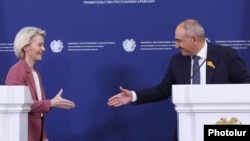
Von der Leyen reaffirmed EU support for Prime Minister Nikol Pashinian and his pro-Western foreign policy that has led to the Russian trade restrictions expected to take a serious toll on the Armenian economy. She again denounced Moscow’s “economic coercion” after her talks with Pashinian.
“We are presenting a proposal for so-called Autonomous Trade Measures that … will liberalize almost 80 percent of Armenian exports to the European Union,” von der Leyen told a joint news conference. “This means that 80 percent of your trade with us will now be tariff free. With this, we can reroute products that currently still rely heavily on the Russian market and send them to the European Union single market of 450 million consumers.”
“This measure will open the European doors for almost 99 percent of Armenia’s fresh fruits, vegetables and plants that used to be exported to Russia, and it will open the doors for more than 90 percent of your exports of beverages and spirits to the European single market,” she said.
Pashinian welcomed the initiative and expressed hope that the EU member states will approve it “in a short time.”
The import liberalization promised by von der Leyen will come on top of 52 million euros ($60 million) in urgent financial aid to the Armenian government approved by the European Commission three days before Armenia’s June 7 parliamentary elections. The money will most probably be used for government subsidies to local food producers finding new export markets.
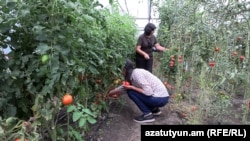
Many export-oriented farmers and agribusiness firms say they will need at least years to find viable alternatives to the Russian market. They are especially skeptical about exporting their products to the EU, pointing to higher transportation costs and the bloc’s stringent food safety standards.
Citing sanitary grounds, Russia blocked imports of Armenian flowers, mineral fruits, vegetables, fish and other agricultural products after Pashinian’s government hosted two European summits in early May. President Vladimir Putin and other Russian officials demanded that the Armenian government quickly choose between seeking to join the EU and remaining part of the Eurasian Economic Union (EEU), a Russian-led trade bloc.
Pashinian remains reluctant to make such a choice now. He made clear after the talks with von der Leyen that Armenia’s eventual membership in the EU continues to be a “strategic goal” of his administration.
“If we manage to become a member of the European Union, it will be a great achievement,” he said.
Pashinian insisted that “the people of Armenia expressed clear support” for this policy in the elections the official results of which gave victory to his Civil Contract party. Armenia’s leading opposition groups, which regard his European integration drive as reckless, have rejected those results as fraudulent.
Moscow has likewise claimed that the elections were marred by many irregularities. Putin has pointedly declined to congratulate Pashinian so far.
By contrast, the EU has described the vote as democratic and hailed its outcome. Von der Leyen said in Yerevan that Armenians voted, among other things, to “partner with the European Union.”
“Together, we must now turn their aspirations into results,” added the head of the EU’s executive body. “You can count on us.”
Armenian exports to Russia reached almost $3 billion last year, compared with $667 million worth of goods exported to EU member states. Russian officials put at $700 million the annual amount of imports from Armenia affected by the trade restrictions.
Russia is in a position to inflict even greater economic pain on Armenia by ending a significant discount on the price of Russian natural gas imported by the country. Russian Energy Minister Sergei Tsivilev warned of such a measure in a letter sent to Yerevan in late May. Another senior Russian official indicated earlier that Moscow could also curb the influx of Russian tourists who he said bring Armenia’s services sector $1 billion in annual revenue.
Von der Leyen announced that a team of EU experts will visit Yerevan next week to advise Armenian officials on how to “diversify energy supply.” She would not say whether the EU could compensate Armenia for a possible surge in the Russian gas price or help the South Caucasus country find an alternative supplier of gas.