


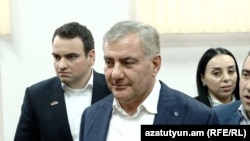
Karapetian floated the idea of a “post-election opposition coalition” in an interview publicized last Thursday. He suggested, in particular, that the opposition forces set up a “coordinating council” that would discuss and take joint actions against the Armenian government.
Former President Robert Kocharian’s Hayastan alliance was quick to welcome the idea. Kocharian heaped praise on Karapetian when he spoke to several reporters on Friday.
“Negotiations are underway, and I think that we will soon have good news,” Kocharian’s son Levon, who also ran for the Armenian parliament on the Hayastan ticket, said over the weekend.
Another senior Hayastan figure, Ishkhan Saghatelian, declined to give any details of those negotiations on Monday.
“All I can say at this point is that discussions between opposition forces are continuing,” Saghatelian told RFE/RL’s Armenian Service.
According to Armenia’s Central Election Commission (CEC), Pashinian’s Civil Contract party won the elections with 49.8 percent of the vote, while Strong Armenia finished second with 23.3 percent, followed by Hayastan and Gagik Tsarukian’s Prosperous Armenia Party which got 9.9 percent and just under 4 percent respectively. These and three other opposition groups rejected the official vote results as fraudulent, challenging them in the Constitutional Court.
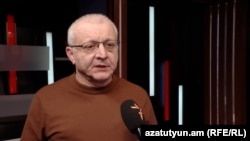
Suren Sureniants, an opposition politician allied to Tsarukian, confirmed that the BHK is also negotiating with Karapetian. Sureniants said the Russian-Armenian billionaire has yet to come up with a “roadmap” to regime change which he believes is a necessary condition for the success of joint opposition actions.
He suggested that Karapetian, Kocharian and Tsarukian will make key decisions at a trilateral face-to-face meeting. No such meeting has been announced so far.
Many opposition supporters are skeptical about the appeals to the Constitutional Court and want the opposition to challenge the election results in the streets. Sureniants argued that the opposition is in no rush to stage such protests because it realizes that it is unlikely to generate a “lightning revolution” in the country and should gear up for a longer struggle.
“Internal and external turbulence around the authorities will not decrease,” said the veteran oppositionist. “Problems will actually get worse. Those include problems related to Nikol Pashinian’s external obligations and very serious problems in Russian-Armenian relations … The opposition should therefore adopt a mid-term program of actions.”