


“The people of Armenia have voted for a future built on peace, stability and stronger cooperation with their neighbors and the world,” EU Council President Antonio Costa said in a congratulatory message also posted on X.
“You can be proud of your role in strengthening Armenia’s resilience, stability and prosperity,” he wrote to Pashinian.
“We deeply value our partnership with a democratic Armenia that is drawing ever closer to Europe,” European Commission President Ursula von der Leyen said for her part. “Armenia can count on us.”
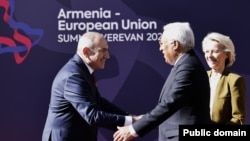
Von der Leyen and Costa met with Pashinian in Yerevan on May 5 for what was billed as the first EU-Armenia summit. It came the day after a European Political Community summit also held in the Armenian capital.
The gatherings were construed by the Armenian opposition as an EU endorsement of Pashinian of ahead of the June 7 elections. The Hayastan alliance, one of the main opposition election contenders, accused the EU of effectively meddling in “Armenia’s internal political processes.”
Opposition leaders have for years accused the West of turning a blind eye to what they call gross human rights abuses in Armenia for geopolitical considerations. During the parliamentary race, some of them deplored the lack of EU reaction to mass arrests of their activists and supporters on vote-buying charges strongly denied by them. The arrests continued on election day.
The European summits also contributed to a further deterioration of Armenia’s relations with Russia, its traditional allies irked by the Armenian government’s desire to join the European Union. Russian President Vladimir Putin said on May 9 that the South Caucasus nation should choose “as soon as possible” between European integration and its continued membership in a Russian-led trade bloc essential for the Armenian economy.
In the following weeks, Russia effectively banned on sanitary grounds multimillion-dollar imports of Armenian agricultural products and beverages. The EU responded by accusing Moscow of seeking to influence the election outcome through “economic coercion.” Von der Leyen said on June 4 that the EU will provide Yerevan with at least 50 million euros ($58 million) in urgent economic assistance.