


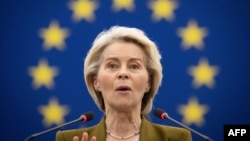
European Commission President Ursula von der Leyen announced the aid after a phone call with Prime Minister Nikol Pashinian. She reiterated the EU’s condemnation of Russia’s decisions to essentially ban the multimillion-dollar import of Armenian fruits, vegetables, flowers and beverages in response to the Armenian government’s efforts to eventually join the EU.
“By extending export restrictions on Armenian products, Moscow is weaponizing economic relations for political pressure,” von der Leyen said in a statement.
“We are preparing an EU support package,” she said. “It includes immediate financial assistance, worth over 50 million euro. And more will come.”
Von der Leyen also promised EU “measures to ease the trade for some Armenian products, in particular agri-food.” Armenia is already making a first shipment of 10,000 flowers to EU member Latvia, she added in that regard.
Armenia reportedly exported 52 million flowers to Russia in January-May 2025 alone. The figure represented an almost 50 increase from the year-earlier period.
Armenian agricultural exports to Russia have also grown rapidly over the past 10-15 years. According to Russian officials, they totaled over $700 million last year. Armenia’s overall exports to Russia reached almost $3 billion, compared with $667 million worth of goods exported to EU member states.
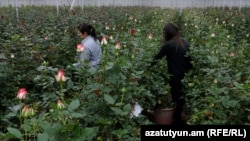
Responding to the Russian import bans imposed over the last two weeks, Pashinian and his close associates have urged domestic farmers and agribusiness firms dependent on the Russian market to diversify their exports. On Thursday, the Armenian government approved subsidies for exporters that will sell their produce in countries other than Russia. They will be paid between 275 and 770 drams ($0.75-$2) for every kilogram of fruits and vegetables and 37 drams per flower exported to the EU or other markets.
Armenian opposition leaders dismissed the financial support as a publicity stunt, saying that Pashinian and his Civil Contract party are misleading the affected voters ahead of Sunday’s parliamentary elections. They as well as some economists and entrepreneurs say that Armenia will need at least years to find new markets. They point to a higher cost of transporting goods to the EU and the bloc’s stringent food safety standards and protectionist policies.
The Russian sanctions followed the May 4-5 European summits in Yerevan during which Pashinian reaffirmed his government’s EU membership ambitions. Russian President Vladimir Putin said on May 9 statement that Yerevan can no longer combine that policy with its membership in a Russian-led trade bloc that gives Armenia tariff-free access to Russia. Moscow has also threatened to stop supplying Russian natural gas to the South Caucasus nation at a significant discount vital for the Armenian economy.
“We are not going to pay for Armenia’s journey to the European Union,” Russian Foreign Ministry spokeswoman Maria Zakharova reiterated on Thursday.