





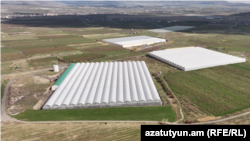
The measure will come into force on Saturday and apply to Armenian vegetables and strawberry exported to Russia in large quantities. The state agricultural watchdog Rosselkhoznadzor claimed to have found dangerous “quarantined objects” in them during an inspection of Armenian greenhouse conducted this week. It accused relevant Armenian authorities of failing to take action over similar violations of sanitary norms detected by it earlier this year.
This and other Russian government agencies also cited sanitary grounds for imposing similar curbs on Armenian cut flowers and banning Armenia’s most popular brand of mineral water late last week. They also slapped a separate ban on wine and brandy produced by three Armenian companies.
In a clearly related development, the Russian government threatened on Wednesday to stop supplying natural gas to Armenia at a significant discount if Yerevan continues to gravitate towards the European Union. These moves come amid Russian leaders’ intensifying criticism of Prime Minister Nikol Pashinian that followed two European summits held in Yerevan early this month.
President Vladimir Putin said on May 9 that Yerevan should choose “as soon as possible” between seeking to join the EU and remaining part of the Eurasian Economic Union (EEU), a Russian-led trade bloc that guarantees Armenian exporters’ tariff-free access to Russia’s market. Putin is expected to raise the matter during an EEU summit in Kazakhstan on Friday. Pashinian will not attend the summit ostensibly because of being busy campaigning for Armenia’s June 7 parliamentary elections.
The Armenian premier continued to downplay the Russian sanctions on Thursday, saying that he can “find solutions to all issues through constructive dialogue” and will not leave the EEU despite his European integration drive. At the same time, he again insisted that their potential impact on the Armenian economy, heavily dependent on Russia for trade and energy, could not be devastating.
“I do not see any threat to Armenia's developing economy. On the contrary, unlimited opportunities are now opening up for Armenia's economy,” he told reporters.
Pashinian singled out the planned opening of a U.S.-transit corridor for Azerbaijan through Armenia. He claimed that it will give a huge economic boost to his country.
Russia is Armenia’s leading commercial partner, having accounted for over 36 percent of its foreign trade last year. Armenian farmers, agribusiness firms and alcoholic beverage makers are particularly reliant on the Russian market.
Other Armenian companies and individual entrepreneurs take advantage of Western sanctions against Moscow by re-exporting large amounts of Western-made goods to Russia. This has been a key driving force behind robust economic growth recorded in Armenia since the 2022 Russian invasion of Ukraine.
“Up to 98 percent of Armenian agricultural exports and almost 80 percent of strong alcoholic beverages go to the Russian market,” the Russian Foreign Ministry spokeswoman, Maria Zakharova, emphasized on Thursday.
Zakharova dismissed Pashinian’s and other Armenian officials’ assurances that they do not want to ruin relations with Moscow. She said Yerevan is reaching “strategic agreements” with Western powers that have “declared a real hybrid war on Russia.”