



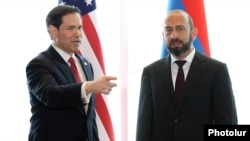
Rubio and Armenian Foreign Minister Ararat Mirzoyan initialed a bilateral agreement on “strategic cooperation” regarding the planned Trump Route for International Peace and Prosperity (TRIPP) following short talks at Yerevan’s Zvartnots international airport.
The agreement reaffirms the key terms of a joint “implementation framework” for the TRIPP signed by the two men in January. Those include the creation of a joint U.S.-Armenian venture that will manage for at least 49 years a railway, a road, energy supply lines and other infrastructure to be built along the Armenian-Iranian border to connect Azerbaijan to its Nakhichevan exclave.
The U.S. government will own 74 percent of the TRIPP Development Company (TDC). The Armenian side is to grant the company “exclusive land use rights, development rights, related permissions, and all other rights” necessary for the transit arrangement.
“Armenia agrees that the TDC shall be empowered to select third parties to support each TRIPP Project established by the SPVs (TDC subsidiaries), including the third parties serving as the concessionaire, sponsors, operators, contractors, and EPC (engineering procurement & construction) providers of such TRIPP Project,” reads the agreement publicized by the Armenian Foreign Ministry.
“This agreement marks the biggest step to date on making this historic route a reality, on advancing peace, on increasing prosperity in Armenia and frankly in the region,” said Rubio, who spent less than an hour at the Yerevan airport on his way back from a visit to India.
“Our relationship is not simply limited to TRIPP,” he told reporters. “We are building upon that in so many different ways, and it’s a top priority of this [U.S.] administration.”
Rubio pointed to a new charter of U.S.-Armenian “strategic partnership” and a memorandum of understanding on the extraction of “critical minerals” signed by him and Mirzoyan. The latter said the documents will open “unprecedented opportunities” for Armenia.

Rubio made the brief stop in the Armenian capital less than two weeks before Armenia’s parliamentary elections. Some Armenian opposition leaders and commentators claimed ahead of his trip that it is designed to boost Prime Minister Nikol Pashinian’s reelection chances. Rubio praised Pashinian but stopped short of explicitly endorsing him, unlike U.S. Vice President JD Vance, who visited Yerevan in February.
“Both yourself and the prime minister [Pashinian] and your entire team here in Armenia are blazing the trail for the brighter and more independent future for Armenia, and we are very happy to be here to show my support for their courage, my support for their vision, my support for their dedication, my support for their willingness to see for the future of their country where it takes to get there. And we are very happy and proud to be a part of that, and we can’t wait to be more together,” said the top U.S. diplomat.
The three main opposition groups challenging Pashinian’s Civil Contract in the June 7 elections say that the TRIPP could endanger Armenia’s vital border with Iran. Some of their leaders have also said that it amounts to the kind of an extraterritorial corridor that has been sought by Azerbaijan and Turkey.
Iranian leaders have likewise spoken out against the TRIPP. They fear that it could lead to U.S. security presence along the Armenian-Iranian border. Some observers believe that Iran is even more opposed to the transit arrangement after its recent war with the United States and Israel.
Speaking at a news conference held after Rubio’s departure, Mirzoyan said the U.S.-Armenian agreement on the TRIPP will be signed after the two sides complete “some technical procedures.” That should happen “within weeks,” he said.