


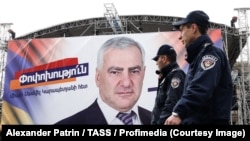
Police took them in for questioning after searching their homes in the northern town of Stepanavan and two nearby villages. They all were understood to be released without charge several hours later.
The detainees included Mher Gevorgian, a former mayor of the village of Gyulagarak, and Vruyr Ayvazian, a local council member running for the parliament on the ticket of Karapetian’s Strong Armenia party. The Investigative Committee said they were rounded up on suspicion of attending or having others attend rallies for money or under duress. Ayvazian said law-enforcement officers confiscated his two home computers as well as his wife’s and mother’s mobile phones.
“I didn’t coerce anyone to do anything, including participating in a rally,” Ayvazian told RFE/RL’s Armenian Service.
In his words, he was specifically questioned in connection with Friday’s protest staged by Strong Armenia outside a court in Yerevan. Hundreds of its supporters rallied there during Karapetian’s unfolding trial to demand the tycoon’s release from house arrest. Some of them jostled with riot police at one point. At least 17 protesters were detained as a result.
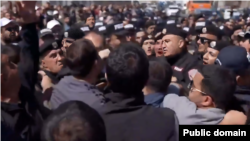
In an extraordinary development, the Investigative Committee charged them with hooliganism and obstruction of the police’s work. Judges did not allow the law-enforcement agency to hold any of them detention, however. Three of the arrested protesters were placed under house arrest while the others were set free.
Senior Strong Armenian members insisted on Monday that the accusations are baseless. One of them, Edgar Ghazarian, said that the arrests of these and other Karapetian supporters are designed to prevent their involvement in unfolding election campaign.
Fourteen such citizens living in the southern town of Artashat were arrested on Thursday on charges of handing out or receiving vote bribes. Karapetian’s party denies the accusations that fueled more speculation about its possible disqualification from the June 7 ballot.
Prime Minister Nikol Pashinian was accused by critics of planning to secure an election victory through fraud or foul play when it emerged in December that his administration requested election-related assistance from the European Union. The EU foreign policy chief, Kaja Kallas, revealed that Yerevan is seeking the kind of “help to fight foreign malign interference” which the EU provided to Moldova ahead of parliamentary elections held there in September 2025. Two Moldovan opposition parties deemed pro-Russian were barred from participating in the elections won by the country’s pro-Western leadership.
Karapetian, 60, has mostly lived in Russia since the early 1990s and has a dual Russian nationality. Pashinian’s political allies have accused the tycoon of plotting to topple the Armenian government on the Kremlin’s orders ever since he entered politics following his controversial arrest last June.