

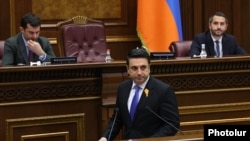
“We do not pose any threat to Russia and we are not going to become a threat, there is no such intention,” parliament speaker Alen Simonian told reporters. “There are some issues, such issues exist between all countries. These issues arise and increase in number at one point, [but then] decrease. The politicians’ job is to discuss and resolve these issues.”
The remarks contrasted with Simonian’s April 4 statement that Armenia will leave Russian-led defense and trade blocs if Russia raises the concessional price of its natural gas or imposes other economic sanctions on Yerevan. The Russian Foreign Ministry scoffed at the threat last week.
Simonian responded to Russian President Vladimir Putin’s stern warnings to Pashinian publicly issued during their April 1 talks in Moscow. In particular, Putin warned Armenian authorities against barring what he called pro-Russian opposition groups or politicians from running in Armenia’s upcoming parliamentary elections.
He also said Yerevan’s moves to eventually join the European Union are “not compatible” with Armenia’s continued membership in the Eurasian Economic Union (EEU), a Russian-led trade bloc. He noted that Russia remains Armenia’s most important trading partner and supplies natural gas to the South Caucasus state at a significant discount.
One of Simonian’s deputies, Ruben Rubinian, insisted on Tuesday that Putin did not threaten to raise the Russian gas price for Armenia.
“The Russian president did not hint at that,” he said. “Such claims are made by some Armenian political forces and the media outlets subordinate to them.”
Pashinian similarly sought to downplay the tensions with Moscow last Thursday, saying that Russian-Armenian relations are merely undergoing “constructive transformation.”